Gold hitting historical highs, what’s next?


Amid sharpening geopolitical frictions, deepening policy uncertainty and a visibly softer dollar, spot gold crossed one after another psychological and historic threshold. For the first time, prices broke above $5,500 an ounce on Thursday, extending a rally that has begun to feel less like a speculative surge and more like a structural realignment of the global financial system.
Wall Street’s largest banks are no longer shy about how far this rally could go. A growing cluster of forecasts now sees gold extending its momentum well into 2026. Bank of America has gone furthest, lifting its near-term target to $6,000 an ounce—the most aggressive call among major institutions.
“History doesn’t repeat itself perfectly, but it often rhymes,” wrote Michael Hartnett, the bank’s chief investment strategist, pointing out that across the past four major bull markets, gold prices rose roughly 300% over an average span of 43 months. By that logic, he argues, $6,000 by the spring of 2026 is less a stretch than a statistical echo.
On Friday, gold prices pulled back by around 3%,yet still at record highs.“In the short term, gold will take a break in the not-so-distant future after a crazy run. But in the long run, sky is probably the limit. Gold holdings by central banks – the major structural driver behind the gold boom in recent years – were not even reaching the 1960s levels,” Tianchen Xu from the Economist Intelligence Unit told China Economic Net.
Vote with vaults
Risk perceptions have been amplified in the market. The flare-up between the United States and NATO allies over Greenland rattled confidence in alliance cohesion. Denmark, Poland and Sweden have either announced or signaled plans to reduce their holdings of U.S. Treasuries. Meanwhile, U.S.-brokered talks between Ukraine and Russia in Abu Dhabi ended without agreement, and tensions surrounding Iran continue to simmer, deepening risk-aversion sentiment across markets.
According to the World Gold Council, 43% of surveyed central banks expect to increase their gold reserves over the next 12 months. Goldman Sachs estimates that official-sector purchases could average 60 tonnes per month this year.
The accumulation even during periods of high volatility, Goldman notes, is evidence that their demand is not particularly price-sensitive. Instead, it reflects a strategic decision to hedge against geopolitical shocks and financial-system risk.
“Weaponization of the dollar incentivizes diversification… As investors look for alternatives to the dollar, the search could provide a powerful ongoing support to gold prices,” Morgan Stanley frames the trend in its Investment Outlook 2026.
“If we look at the dollar’s real effective exchange rate, it’s still quite high by historical comparison, so there’s still downside room, and 2026 is going to be a turbulent year for the dollar. A hefty fiscal deficit, in particular, will raise the risk premium to hold US dollar assets,” Xu said.
Some see this as a generational shift. Guy Wolf, Global Head of Market Analytics at Marex, a UK financial firm, argues that the reallocation of reserves toward gold could persist for 10 to 20 years, providing firm long-term support for bullion.
Beyond geopolitics lies a more prosaic concern: America’s balance sheet. Rising debt levels and persistent deficits have revived questions about fiscal sustainability, eroding the appeal of dollar-denominated assets.
Monetary policy is reinforcing the trend. With the Federal Reserve’s easing cycle intact, cooling labor markets and contained inflation have given policymakers room to stay accommodative. On January 28, the Fed held its benchmark rate at 3.50%–3.75%, in line with expectations. But the decision masked deeper fractures: two of the 12 voting members dissented, marking the fifth consecutive meeting with internal opposition—a rare signal of institutional discord.
“The transition toward gold and away from the greenback is also being driven by large U.S. deficits and question marks over future Federal Reserve policy,” Vincent Mortier, chief investment officer at Amundi, Europe’s largest asset manager, indicated in an interview with Bloomberg Television.
Anything But Dollar
In the long term, as the independence of the Federal Reserve weakens and internal policy rifts continue to intensify, coupled with the rising deficit rate constantly eroding the credit of the U.S. dollar and treasury bonds, the global trend of “de-dollarization” is expected to be reinforced.
In a World Gold Council survey, 75% of central banks said they expect the dollar’s share of global reserves to decline moderately or significantly over the next five years.
The shift is becoming increasingly blatant. India’s holdings of long-term US Treasuries have fallen to $174 billion, a five-year low and 26% below their 2023 peak. Poland’s central bank has announced plans to add another 150 tonnes of gold to its reserves. And while the dollar remains the world’s dominant reserve currency, bilateral currency swap lines are becoming a crucial lubricant in a less dollar-centric system. As of September 2025, China’s central bank had active swap agreements with 32 countries and regions, totaling roughly 4.5 trillion yuan.
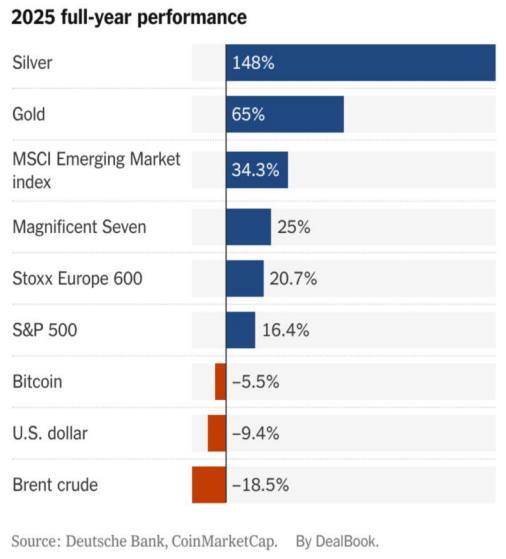
Gold is not alone. The entire precious-metals complex turns bullish. Silver is enjoying its strongest start to a year since records began in 1972, trading near $114 an ounce, up about 60% year to date, after a staggering 150% gain in 2025. Platinum and palladium have also hit record highs of over $2,000. HSBC notes that platinum’s structural deficit could widen to 1.2 million ounces this year, attracting investors who increasingly view it as a “cheaper substitute for gold.”
The reallocation is global. Investors and central banks alike are trimming exposure to U.S. assets in favor of diversification. Emerging markets are a prime beneficiary. According to Goldman Sachs’ Emerging Markets Equity Fund Q4 2025 Commentary, the MSCI Emerging Markets Index rose 4.73% in the fourth quarter last year, taking full-year gains to 33.57%, its strongest performance in eight years. The rally has continued into 2026, with the index up roughly 7% year to date, led by Asian technology stocks.
“Emerging market equities have the highest expected base-case real return, at 8%, to which we assign a 55% probability,” wrote Sharmin Mossavar-Rahmani, chief investment officer at Goldman Sachs Wealth Management. “The volatility in our base case for emerging markets is the greatest among all the markets.”
by Wang Kai